Mekap Pro Safety Footwear – User Manual
USER INFORMATION
SHOE CARE
Our footwear is manufactured with the utmost care using the latest technology and high-quality materials to ensure your safety and comfort.
STORAGE
Before and after use, store your footwear in a dry, well-ventilated place and keep it away from heat sources.
The storage period is 2 years from the date of manufacture.
CLEANING
Remove dust and dirt with a brush.
Remove stains with a damp cloth and, if necessary, use soap.
Finally, you may apply a suitable shoe polish.
USE
CE MARKING
The CE marking on the product indicates that:
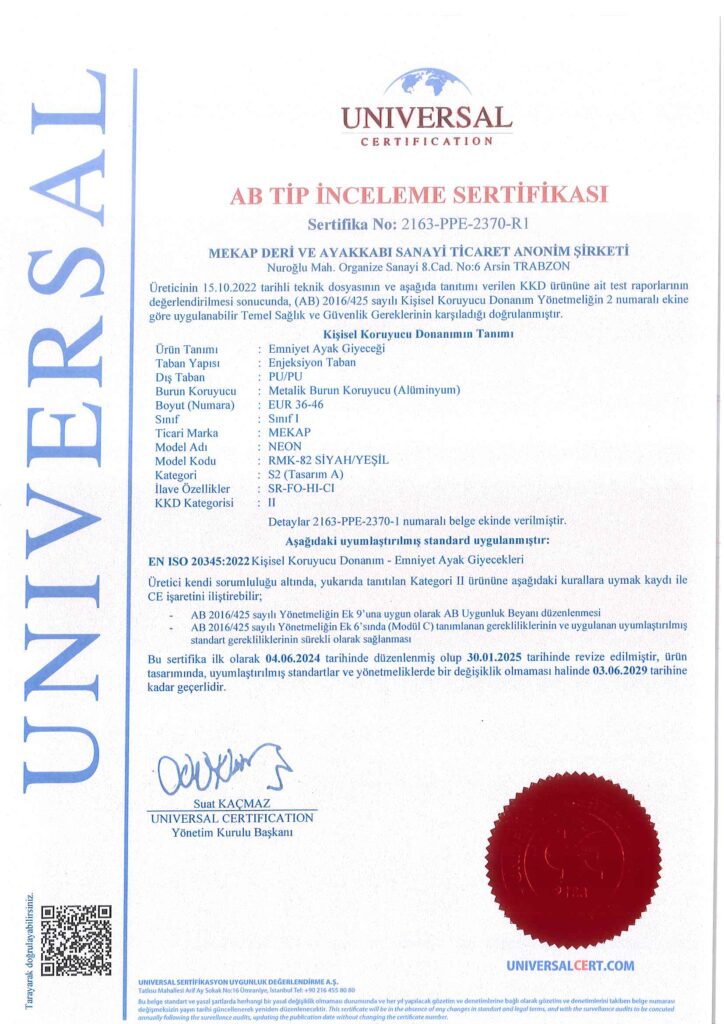
The product complies with the essential requirements of Regulation (EU) 2016/425 of the European Parliament and of the Council on personal protective equipment (PPE), in accordance with the applicable requirements.
Safety
Comfort
Abrasion resistance
Additional protection against the risk of slipping
The safety footwear has been tested by a notified body in accordance with the applicable European standards.
IDENTIFICATION
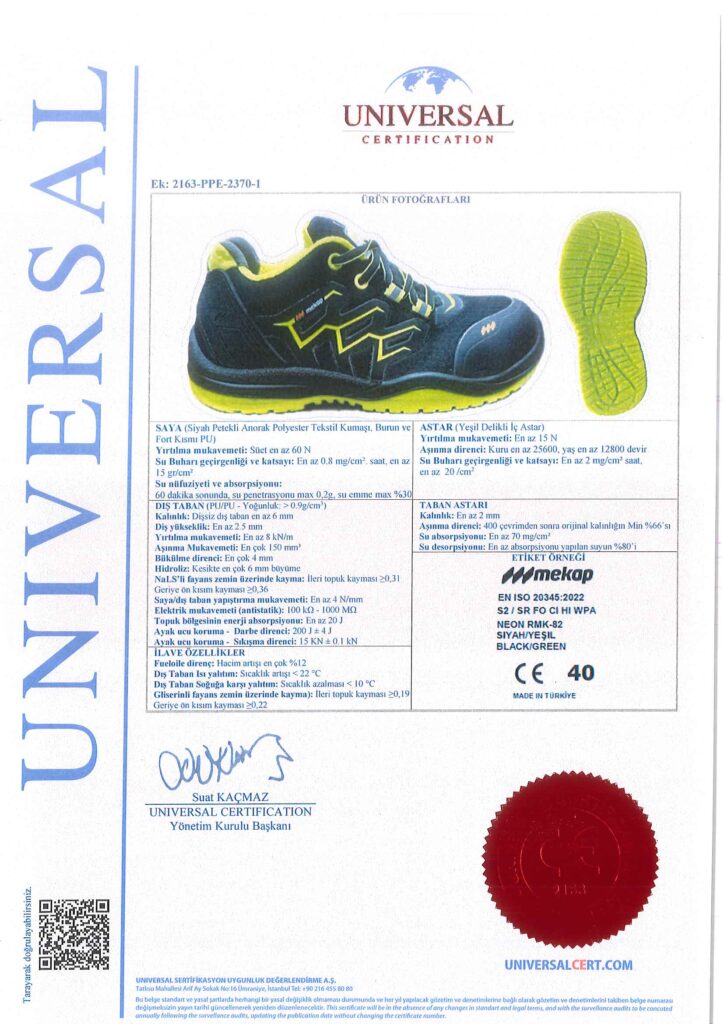
The product standards S1/S1P/S2/S3, 01/01P/02/03 and other markings corresponding to the product standards EN ISO 20345:2022 / EN ISO 20347:2022, together with the SR slip-resistance marking, size, product name and product code, shoe size, CE marking and information concerning the place of manufacture, can be found on the footwear labels.
The name and address of the manufacturer can be found below the example.
The product Declarations of Conformity can be consulted at:
TOE CAP
The toe cap indicates protection against an impact energy of 200 J (EN ISO 20345:2022) and compression under a load of 15,000 N (EN ISO 20345:2022).
BASIC PENETRATION RESISTANCE
METAL INSERTS (TYPE P)
Metal penetration-resistant inserts for footwear must withstand a penetration force of at least 1,100 N when pressure is applied using a 4.5 mm nail.
NON-METALLIC INSERTS
Type PL: Footwear with a non-metallic penetration-resistant insert shows no penetration when a 4.5 mm nail is applied with a force of 1,100 N.
Type PS: Non-metallic penetration-resistant inserts must withstand a penetration force of at least 1,100 N when pressure is applied using a 3 mm nail.
SLIP RESISTANCE
This means that the required slip resistance is achieved on a ceramic tile surface (E2) moistened with a diluted solution of sodium lauryl sulfate (SLS).
SR – SLIP RESISTANCE
SR (Slip resistance on ceramic tile + SLS and ceramic tile + glycerine):
This means that the required slip resistance has been achieved on a ceramic tile surface (E2) moistened with sodium lauryl sulfate (SLS) and on a ceramic tile surface (E2) using glycerine as a lubricant.
INSOLE
The footwear is supplied with a removable insole and testing must be carried out with the insole fitted.
The footwear must only be used with the insole in place.
The insole may only be replaced with a comparable insole supplied by the original footwear manufacturer.
ANTISTATIC FOOTWEAR
Antistatic footwear should be used where it is necessary to minimise the accumulation of electrostatic charges by dissipating electrostatic charges, thereby avoiding, for example, the risk of ignition of flammable materials and vapours, and where the risk of electric shock from mains-voltage equipment cannot be completely eliminated in the workplace.
Antistatic footwear creates electrical resistance between the foot and the ground, but may not provide complete protection.
Antistatic footwear is not suitable for work on live electrical installations.
However, it is important to emphasise that antistatic footwear, because it only creates resistance between the foot and the ground, does not provide adequate protection against electric shock caused by static discharge.
If the risk of electric shock caused by static discharge cannot be completely eliminated, additional measures are required to prevent this risk.
Such measures, together with the additional tests described below, should form a regular part of the occupational accident prevention programme.
Antistatic footwear does not provide protection against electric shocks from alternating current (AC) or direct current (DC).
Where there is any risk of exposure to AC or DC voltage, electrically insulating footwear should be worn to protect against serious injury.
The electrical resistance of antistatic footwear can change significantly due to stretching, contamination or moisture.
This footwear may not function properly when worn in wet conditions.
If footwear must be worn in contaminated conditions, the wearer should always check the antistatic properties of the footwear before entering a hazardous area.
Class I footwear can absorb moisture and become conductive if worn for extended periods in damp or wet conditions.
Class II footwear is resistant to damp and wet conditions and should only be used where there is a risk of exposure to such conditions.
If footwear is worn under conditions where the sole material becomes contaminated, the wearer should always check the antistatic properties of the footwear before entering a hazardous area.
When antistatic footwear is used, the resistance of the floor must be such that it does not compromise the protection provided by the footwear.
It is recommended to use antistatic socks.
Therefore, it is necessary to ensure that the combination of the footwear wearer and the surrounding environment is capable of performing the intended function, namely the dissipation of electrostatic charges, and that it provides an appropriate level of protection throughout the service life of the footwear.
For this reason, it is recommended that the user carry out an internal electrical resistance test, which should be repeated regularly and frequently.